Plan first.
Build second.
claude mcp add --transport http --scope user nodeon https://www.nodeon.app/api/mcpDesign your projects anywhere, anytime
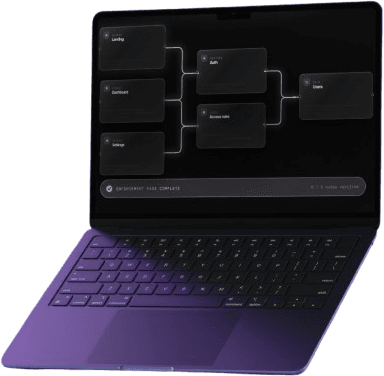
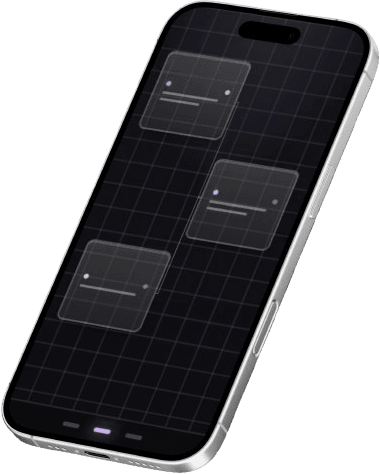
One graph, synced everywhere. Sketch a structure on your phone, refine it at your desk, and your agent pulls the same plan through MCP.
How it works
Map. Generate. Connect.
Structure your app visually, then let your agent pull context via MCP.
- 01
Map it
Drop nodes on a canvas: screens, data models, features, dependencies. Connect them. This is your app's structure, not a prompt, not a wireframe.
- 02
Generate
Nodeon reads the full graph and produces CLAUDE.md, cursor rules, spec sheets, and a dependency-ordered task sequence. Each task gets only the context it needs.
- 03
Connect
Your agent connects via MCP and pulls task context on demand. It marks nodes done, adds discovered subtasks, and flags blockers. The graph stays in sync.
The canvas
Four node types. That's the whole language.
Everything you plan is some arrangement of these. No syntax to learn, nothing to memorise.
Screen
A page or view. Layout, state, and navigation.
Feature
A capability. Auth, search, upload, checkout.
Logic
Rules and flow. What happens, when, and why.
Data
Models and relations. Schemas, fields, constraints.
What you get
Agent infrastructure for complex apps.
An MCP tool that gives your coding agent structured context, not another prompt window.
MCP server
Your coding agent connects to Nodeon via MCP and pulls task context on demand, node by node, in dependency order. No copy-paste, no file wrangling.
Freebuild web UI
Build and edit your mindmap on a canvas. Drag nodes, draw dependencies, refine specs. AI-assisted editing for splitting nodes, tightening vague descriptions, and reordering.
CLAUDE.md and cursor rules
Nodeon generates .md docs your agent already reads: CLAUDE.md, cursor rules and spec sheets. They stay in sync with your graph because they're derived from it.
Agent write-back
Your agent marks nodes done, adds discovered subtasks, and flags blockers. The graph is live project state, not a static plan.
Dependency-aware ordering
Nodeon figures out what to build first. Screens depend on data models. Features depend on auth. The export is sequenced so your agent doesn't have to guess.
Scoped context per task
Each node gets only the context it needs: what it depends on and what depends on it. Not the whole graph. Computed at edit time, cached for instant reads.
Why planning matters
The brief is the bottleneck.
Agents don't fail because the model is bad. They fail because the input is underspecified and out of order.
Ad-hoc prompting
- Input is structured
- A paragraph in a chat
- Agent sees dependencies
- Only what you remember to mention
- Prompts are ordered
- No. You prompt in whatever order
- Scope is defined upfront
- It isn't
- Agent can write back
- No. Chat is one way
- Agent access method
- Copy-paste into chat
Prompt templates
- Input is structured
- A copy-paste scaffold
- Agent sees dependencies
- Static. Doesn't know your project
- Prompts are ordered
- Partial. Templates have a fixed order
- Scope is defined upfront
- Template-level, not project-level
- Agent can write back
- No. Templates are static
- Agent access method
- Copy-paste into chat
Nodeon
- Input is structured
- A visual graph with typed nodes
- Agent sees dependencies
- Every node includes its connections
- Prompts are ordered
- Yes. Dependency sorted export
- Scope is defined upfront
- Scoped per node, validated across graph
- Agent can write back
- Yes. Marks done, adds subtasks, flags blockers
- Agent access method
- MCP server or file export
Pricing
Simple pricing, two tiers.
Nodeon opens on October 1. Pick a tier then. Unlimited agent calls on both, metered only on AI edits.
Monthly subscription, billed through Stripe. Cancel any time; access runs to the end of the paid month.
- Everything unlocks on October 1
- Unlimited agent calls through MCP
- Freebuild web UI and the mobile app
- 300 AI edits every month
- Cancel any time from your dashboard
- Nothing charged before launch day
Nodeon opens on October 1.
Secure checkout by Stripe. Opens October 1, 2026.
Pricing after launch
These are the prices at launch. They may change for people who sign up later, and your rate does not change while your subscription stays active.
FAQ
Questions, answered straight.
If something here is still unclear, email us before you pay, not after.
An MCP tool and agent infrastructure for mapping complex apps. You lay out your project as a node graph, screens, data models, logic, dependencies. Nodeon converts that into CLAUDE.md, cursor rules, spec sheets, and dependency-ordered task sequences your agent consumes via MCP.
MCP (Model Context Protocol) is how AI agents connect to external tools. Nodeon exposes your graph as an MCP server, so Claude Code, Cursor, Codex, or Windsurf can pull task context on demand, node by node, in dependency order. No copy-paste, no file wrangling.
A prompt is a paragraph the model interprets once. Nodeon gives you a structured graph: dependency-ordered tasks with scoped context, acceptance criteria, and data contracts. Your agent builds from a sequenced spec, not a vague one-liner. And the agent can write back, marking tasks done, adding subtasks, flagging blockers.
CLAUDE.md, cursor rules, spec sheets, and a dependency-ordered task sequence. Each task includes only the context it needs, what it depends on, what depends on it. Not the whole graph.
A canvas where you build and edit your mindmap manually. Drag nodes, draw dependencies, refine specs. AI-assisted editing for splitting nodes, tightening vague descriptions, and reordering dependencies.
Yes. Your agent marks nodes done, adds discovered subtasks, and flags blockers. The graph is live project state, not a static plan. That's the point, your specs stay in sync with reality.
Anything that speaks MCP or reads files. Claude Code, Cursor, Codex, Windsurf, and similar tools. The MCP integration gives agents live access to your graph. File export works with anything that reads plain text.
No. Nodeon produces the brief your agent builds from, CLAUDE.md, cursor rules, spec sheets, task sequences. It doesn't generate code, run builds, host anything, or deploy to app stores. Your agent does the building. Nodeon does the planning.
Two tiers. Core is $6/mo with 300 AI edits a month. Pro is $35/mo with 2,000 AI edits a month. Both include unlimited agent calls through MCP.
Nodeon opens to the public on October 1, 2026. That is the launch. Everything unlocks at once, nothing is charged before then.
An AI-assisted change to the graph in the Freebuild UI: splitting a node, rewriting a description, reordering dependencies. Your agent reading the graph through MCP does not count and is never metered.
AI edits pause until your next billing month. Your agent can still read the graph through MCP with no limit. Manual edits in the Freebuild UI are also unaffected.
The AI edit allowance, priority model capacity, and priority support. Everything else is identical. Core is not a reduced product; both tiers give you the full platform.
Any time from your dashboard. Your subscription stops renewing and access continues to the end of the billing period you already paid for. No partial refunds.
No. Anything that speaks MCP works. Claude Code, Cursor, Codex, Windsurf, or any tool that can connect to an MCP server.
Stop re-prompting.
Nodeon launches October 1 at $6 a month. Get CLAUDE.md, cursor rules, and spec sheets that stay in sync with your actual plan.
Nodeon opens on October 1.
Nodeon opens on October 1.